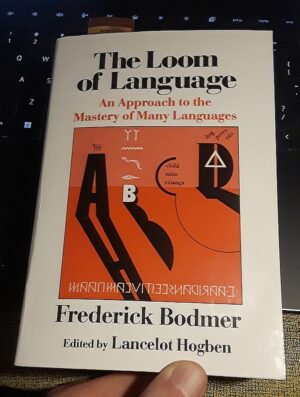
I’ve been working my way through Frederick Bodmer’s The Loom of Language (1944). The following passage from Part Two, Chapter VI (pp. 213 – 214) struck me as particularly relevant to how people still talk about language learning today. He argues that many learners blame “poor memory” for their struggles, yet the same people, if they happen to enjoy gardening or natural history (or, presumably, any other hobby) have no trouble absorbing long lists of plant names, zoological terminology (or other data points relevant to their chosen hobby). The difference, he suggests, is not memory at all. It is attention and interest.
Some people complain of poor memory, and attribute to it the difficulties of learning a foreign language. If also fond of horticulture or of natural history, they do not complain about the difficulty of memorizing a copious vocabulary of technical terms. So a poor memory is rarely a correct explanation of what holds them back. One of the essential obstacles is that the interest of the beginner is focused exclusively on a remote goal. It is not also directed, like that of the naturalist, to the material itself. To learn with least effort we have to become language-conscious. If The Loom of Language has succeeded in its task so far the reader who has not studied languages before, and the reader who has studied them without thinking much about their family traits, will now be more language-conscious.
His notion of becoming “language-conscious” rings true for me. Bodmer is not talking about formal linguistics, but about cultivating a curiosity for how languages work, such as noticing patterns, comparing structures, paying attention to the “material itself” rather than only the distant goal of (so-called) “fluency.” A naturalist delights in the details of a leaf or an insect wing. A language learner, he implies, should learn to delight in topics such as the mechanics of grammar, the etymology of words, and the way meanings travel across related languages.
Bodmer continues:
The most important is to concentrate on learning a relatively small class of words before trying to learn any others. This class includes the particles, pronouns, pointer words, and helper verbs. There are several reasons for doing this. One is that a battery of about one hundred and fifty of such words for ready use, supplemented by a nodding acquaintance with about a hundred others, includes a very high proportion of the words we constantly use or constantly meet on the printed page. A second is that what verbs, adjectives, and nouns we commonly meet, especially the nouns, depends on individual circumstances and tastes. A third is that it is easier to guess the meaning of nouns, adjectives, and verbs when we meet them. This is partly because an increasing proportion of new words of this kind are international, and also because the particles are the most unstable elements in a language. We do not borrow prepositions or conjunctions, but we constantly borrow nouns, verbs, or adjectives, and such borrowed words play an important part in modem life. The word for a telephone or for a museum is recognizably the same in English, Swedish, Serbo-Croat, or Hungarian; but the Dane who learns the word rabbit in his first lesson from the English primer commonly used in Danish schools may live ten years in Nottingham or correspond regularly with a friend in New York without getting involved in a discussion about rodents* of any kind.
For many language learners, this reframing is liberating. Instead of seeing language study as a long march toward some far-off proficiency, it becomes a process of discovery. Curiosity empowers motivation. And once you start noticing how languages behave, how they borrow, evolve, and relate, you begin to see why some parts of a language might be more worth learning early on than others.
This leads to Bodmer’s second point, which is that beginners should focus first on a small, high-frequency class of words. He lists these as particles, pronouns, demonstratives, and helper verbs, along with roughly a hundred other common words. He argues that these are the structural core of everyday communication, and that they appear far more often than most nouns or adjectives. Additionally, as Bodmer notes**, nouns and verbs are increasingly international, especially within languages that have developed from the same root family. An example he uses is that a modern learner can often guess the meaning of “telephone” or “museum” across languages, but not the meaning of “although,” “unless,” or “might.”
The words for “telephone” and “museum” are indeed similar across several Indo-European languages, while a word like “rabbit” varies wildly and is far less likely to appear in a beginner’s reading or general conversation anyway. Therefore, beginners will probably be better served focusing on memorizing particles, pronouns, demonstratives, and helper verbs, along with other unique but high-frequency vocabulary, while simultaneously noticing cognates. This can greatly reduce the initial task of vocabulary memorization that is required to get one started in a language at a basic functional level.
*Rabbits used to be classified as a type of rodent. I think that changed in 1912. Bodmer, writing in 1944, apparently never got the memo.
**Here are examples for telephone, museum and rabbit in the languages Bodmer mentions in the quote:
Swedish: telefon, museum, kanin.
Serbo‑Croatia***: telefon, muzej, zec.
Hungarian: telefon, múzeum, nyúl.
Danish: telefon, museum, kanin.
Bodmer’s example of “telephone,” “museum,” and “rabbit” also matches my experience in studying Spanish, with the Spanish for telephone and museum being cognates to the English terms, while rabbit comes from a completely different root: teléfono, museo, and conejo.
***Although I refer here to “Serbo‑Croatian” as a single language for convenience, this term is now used primarily in a linguistic context rather than general popular use. Since the breakup of Yugoslavia, the region’s successor states have developed and promoted their own standard languages, each with their own official statuses and cultural identities, such as Bosnian, Croatian, Montenegrin, and Serbian. Linguists continue to use “Serbo‑Croatian” (or BCMS) as a neutral umbrella term for the shared South Slavic dialect continuum underlying these standards, which remain highly mutually intelligible. My use of the term here follows that technical, descriptive sense rather than any political one.
Related Posts:
Bodmer-inspired Starter Vocabulary: Spanish